I Pay Creators for What They Sell and What Gets Watched, Not for Their Followers
A content creator program that pays for every purchase made with the creator's code and for the real views of their Reels, with a wallet they can see and withdrawals only against a validated fee receipt.

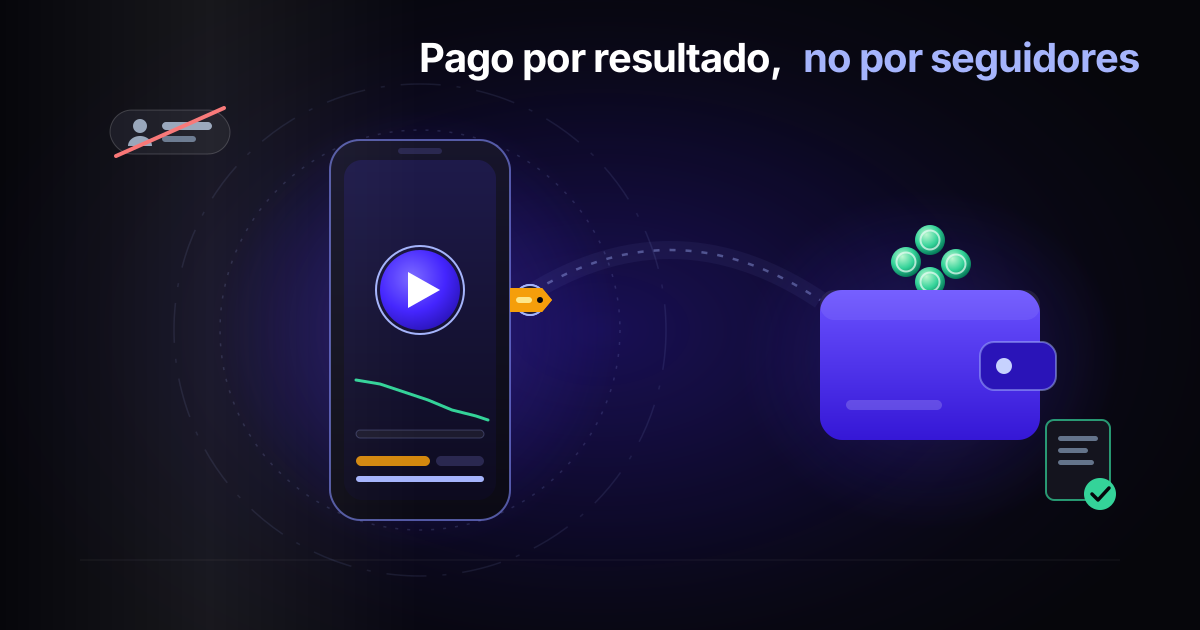
The usual way to pay a content creator is by follower count. You look at the number on the profile, negotiate a fee and pay up front. What happens next, whether anyone bought or whether anyone watched the whole video, you learn late or never.
At the Chilean eCommerce I built this program for (a retail store and a wholesale store, with two warehouses of their own), we decided to do it the other way around. The program is for UGC Creators. UGC stands for User Generated Content: content made by regular people about products they use, on their own social accounts, instead of a piece produced by the brand. The creator gets paid for what they sell and for what actually gets watched. Nobody asks how many followers they have.
Apply without asking anyone for permission
Creators apply on their own, through a form on the online store. As soon as they submit, they get an email confirming it: "We received your application", with the process explained exactly as it works. The team reviews it and, if approved, a second email invites them to create their profile.
On approval, the system creates their personal discount code, their account and their portal. In the portal the creator goes through steps that can't be skipped: welcome, terms and conditions (accepted as a contract before the rest is explained), how they want to take part, how it works, and their details. No automated process runs for anyone who hasn't accepted the current terms: without that, there are no campaigns, payments or withdrawals.
The form doesn't ask for a follower range. It doesn't need to: payment depends on what happens after posting.
First way to get paid: every purchase made with their code
Every time someone buys with the creator's code, the creator earns a share of that purchase. The rule is anchored to the store's average order value, which is CLP 80,000:
- An $80,000 purchase pays $2,000, the maximum per purchase.
- Below $80,000 it pays in the same proportion: 2.5% of the purchase. A $40,000 purchase pays $1,000.
- Above $80,000 the cap holds: a $120,000 purchase also pays $2,000.
The cap has a practical reason: the cost of each sale stays bounded and can be calculated in advance. The creator never sees sales amounts, which are the company's confidential information. They see how many times their code was used and what they earned.
Second way to get paid: views that are actually watched
The other option pays for Instagram Reels. Each approved Reel pays views × rate, and the rate goes from $0.2 to $0.5 per view depending on a quality score from 0 to 1: rate = $0.2 + $0.3 × score.
The score comes from three metrics Instagram shows in the Reel's insights:
- Skip rate (30%): how many people scroll past in the first 3 seconds. Full score at 30% or less, zero at 60% or more.
- Average watch time (40%), as a percentage of the Reel's length. Full score at 60% or more, zero at 20% or less.
- End retention (30%): how many reach the last second. Full score at 40% or more, zero at 10% or less.
Total watch time doesn't go into the score, but it does something more important: it checks that the numbers add up. The rules that round out this option:
- Under 1,000 views the Reel doesn't pay.
- The maximum is $50,000 per Reel (a campaign can set a different one) and up to 4 Reels a month are paid per creator. The option also has a monthly spending quota.
- The Reel must show the product, mention the store's account, include the code in the caption, be labeled as advertising and stay up for at least 30 days.
- Buying views, using bots or boosting the Reel with paid ads is forbidden. If it happens, the Reel isn't paid and the creator is removed from the program.
How to measure a Reel without taking anyone's word for it
Measuring at 30 days is what makes the rate fair: by then the Reel has delivered almost everything it was going to. The flow is almost entirely automated:
- The creator registers the Reel in their profile within 72 hours of posting and sees the requirements checklist.
- The team checks once that it complies. If not, the creator has 48 hours to fix it.
- On day 30, an email asks for the insight screenshots and a screen recording opening the Reel from their profile. If they aren't uploaded within 15 days, the Reel isn't paid.
- An AI model reads the screenshots and proposes the values; the creator confirms or corrects them.
- The system calculates the score and the payment, and checks consistency: if total watch time is more than 10% off from views × average watch time, or if the creator corrected what the AI read, the Reel goes to "Review".
The AI doesn't decide the payment. It reads numbers off an image; the rule and the person who approves do the rest.
A wallet in plain sight and a receipt before every withdrawal
What the creator earns goes into their wallet: a balance inside their profile with the available balance, the balance in process, the total paid and the history of every movement. The history is an append-only ledger: nothing is edited or deleted, and any correction is recorded as a new adjustment with its reason.
Creators enter their own bank details in their profile, and the account must be under their own tax ID (RUT). The details are stored encrypted; outside accounting, only the bank, the account type and the last four digits are visible. Changing the account requires an email confirmation and blocks withdrawals for 48 hours.
For withdrawals, the rule has no exceptions: no fee receipt, no withdrawal. In Chile, an individual who invoices for services issues a boleta de honorarios, a fee receipt with tax withholding. The minimum withdrawal is $100,000 and only one can be in process at a time. The system tells the creator what gross amount to issue the receipt for and checks it as soon as it's uploaded: issuer, recipient, amounts, date and serial number. If something doesn't match, it says so before sending. Then accounting gets an email notice, validates the withdrawal and transfers within 5 business days.
The company covers the withholding: the receipt is issued for the gross amount, which is the net ÷ (1 − 15.25%) at the 2026 rate, and the creator receives the full amount they withdraw.
Product campaigns: prove it first, receive it after
There's a third way to take part, with no money involved. The team builds campaigns in the system, choosing products with the same SKU search used for rewards and exchanges, which already leaves out excluded items and anything out of stock. Each campaign sets slots, dates and a minimum of valid orders per month with the code: 10 by default. When one opens, creators get an email.
The creator applies, the team selects based on the slots, and the shipment follows the same path as an exchange: an automatic quote in the ERP, internal approval and dispatch. The products are for creating content; they can't be sold or transferred. To apply to another campaign, their code has to reach that campaign's minimum in some month after delivery. A valid order is one that's paid, not returned, not a self-purchase, and counts once per customer per month.
What the business gains
A cost that moves with results. Every peso that leaves the program matches a purchase made or a view someone watched, measured with rules the creator knows before starting and can check in their profile. Followers stop being the currency of the negotiation: a small profile with good content earns more than a big one nobody watches to the end. It's the same idea as the big lie of influencer marketing, turned into a system, and it builds on discount codes that are held accountable.
If you pay creators without knowing what they bring back, start with an AI diagnosis for your company.
Contact me