Your ROAS Doesn't Have a Creative Problem. It Has an Awareness Problem.
When you scale budget on Meta and ROAS drops, the instinct is to blame the creative. The problem is almost always structural: you don't have content for the 5 stages of awareness.


Most brands run ads only for people who already know they need the product.
With a low budget, this works. You're fishing in a warm pond. There's enough hot demand to sustain the ROAS you see on screen. The problem shows up when you scale.
As you increase the budget, Meta has to go out and find colder audiences. And your message — designed for someone who already knows the product, who is already comparing options, who already knows they have the problem — is completely irrelevant to them.
That's not a creative failure. It's a funnel that doesn't exist.
The framework that explains everything: the 5 stages of awareness
In 1966, copywriter Eugene Schwartz published Breakthrough Advertising, a book almost nobody read outside the world of direct marketing. In it he described something that's more relevant today than ever: buyers are not all in the same mental place.
Depending on how much they know about their problem and about your solution, they fall into one of these 5 stages:
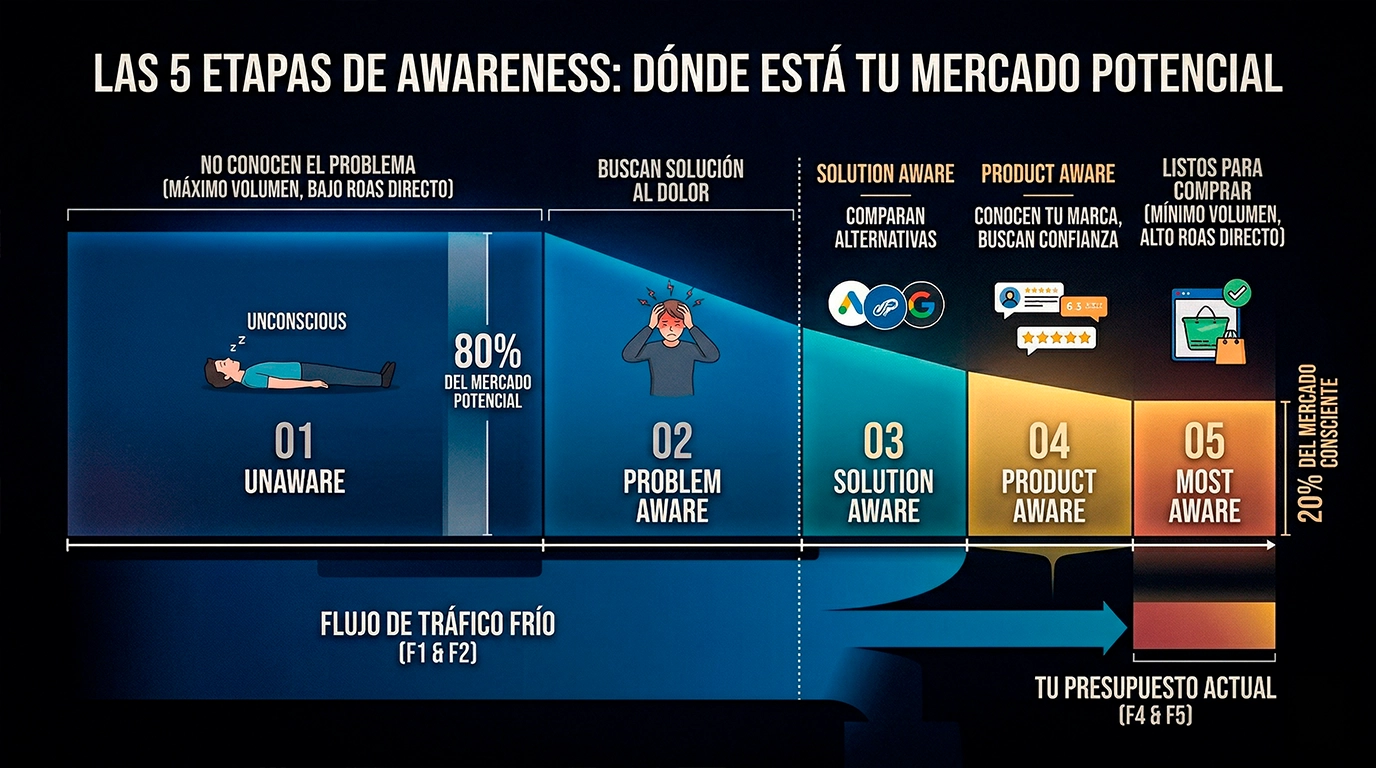
Why 80% of ads target 20% of the market
If you look at most Meta Ads accounts that struggle to scale, you'll see the same pattern: almost all the spend is concentrated in stages 3, 4 and 5.
Retargeting of site visitors. Lookalike audiences of buyers. Testimonials. Limited-time offers. All correct, but not enough to scale.
The problem isn't that your ads are bad. It's that you're fishing in the smallest puddle of the lake and you're surprised you don't catch more fish.
Stages 1 and 2 make up the bulk of the potential market. These are the cold audiences Meta starts reaching when you scale the budget. And they're exactly the people your "Buy now with 20% off" ad says nothing to.
How to build the missing funnel
The solution isn't a hack or a secret Meta setting. It's creating content that speaks to each stage honestly and relevantly.
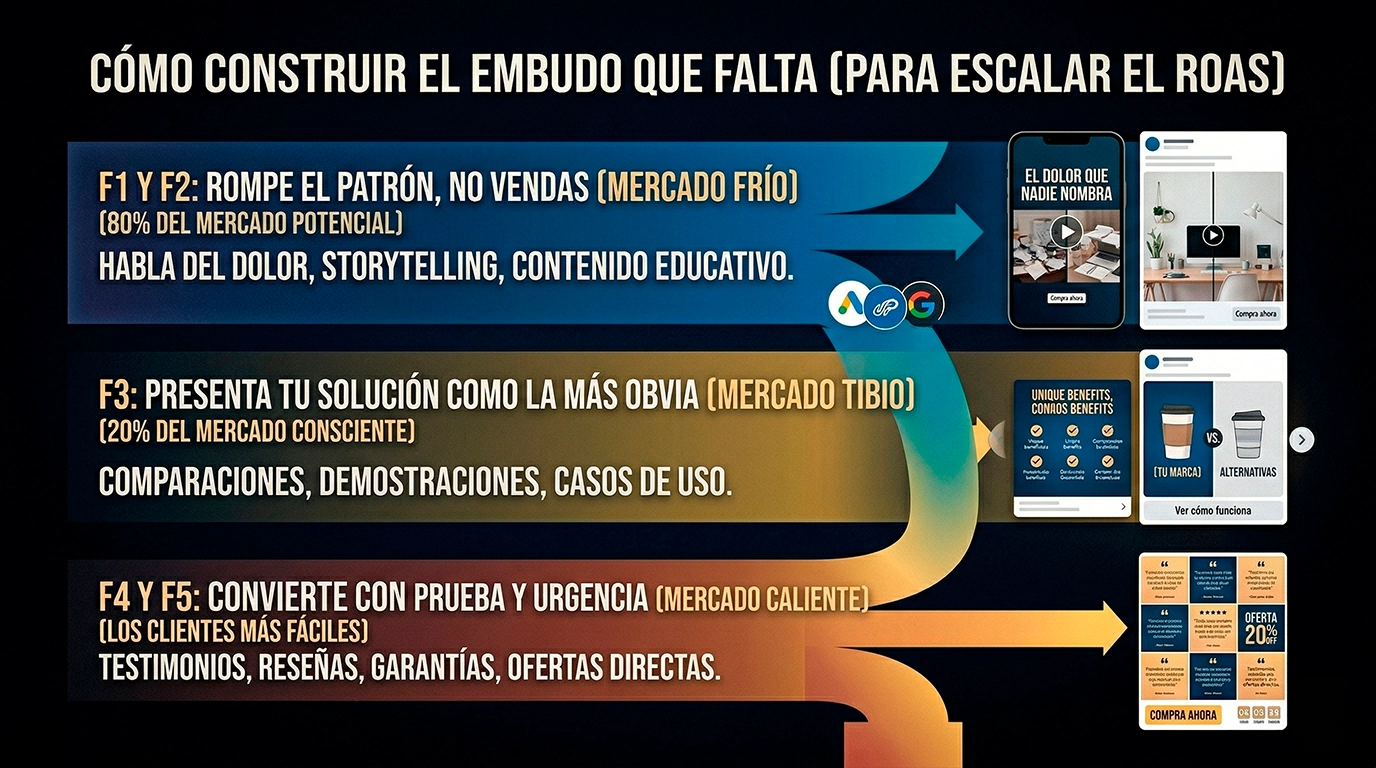
Stages 1 and 2: Break the pattern, don't sell
For audiences with no awareness or only problem awareness, educational content and storytelling work better than any offer. A video that names the pain without mentioning the product can have more impact on long-term ROAS than ten conversion ads.
Stage 3: Present your solution as the most obvious one
Here you compete with alternatives. The job is to explain why your approach is superior, not just that your product exists. Comparisons, demonstrations, use cases. Show how you solve the problem in a way others can't.
Stages 4 and 5: Convert with proof and urgency
Real testimonials, reviews, guarantees, demos. And at the hottest stage, a direct offer with a reason to act today. This is the part of the funnel where you already have permission to be direct.
ROAS isn't the problem. It's the symptom.
When ROAS drops as you scale, most ad teams panic and start swapping creatives, pausing ad sets and adjusting bids. It's like treating a fever with ice while the underlying problem stays intact.
The right question isn't "which creative works best?" The right question is: which awareness stage is this ad designed for, and which stage am I showing it to?
If 80% of your budget targets stages 3 to 5, there's a scaling ceiling you won't be able to break no matter how much you optimize. Not because the algorithm fails, but because the available market in those stages is finite.
Fix the funnel. ROAS follows on its own.
This isn't a promise of magic. It's basic math: more market covered, with the right message, at the right moment, produces more volume at a sustainable acquisition cost. That's the definition of scaling well.
Let's talk about how to apply this to your business.