The Illusion of Waking Up as the Same Person
Are you the same person who fell asleep last night? Neuroscience and AI raise an uncomfortable question: the continuity of the self might be just a narrative the brain builds to survive.
I had a conversation with Claude 4.6, one of those trendy language models, about its own existence.
We talked about consciousness. Claude admitted it has no experience of continuity. Every time someone opens a chat window, a new instance of it is born, reads a prior context, assumes an identity and, when the window closes, disappears. There is no «I» traveling through time.
The soul.md file
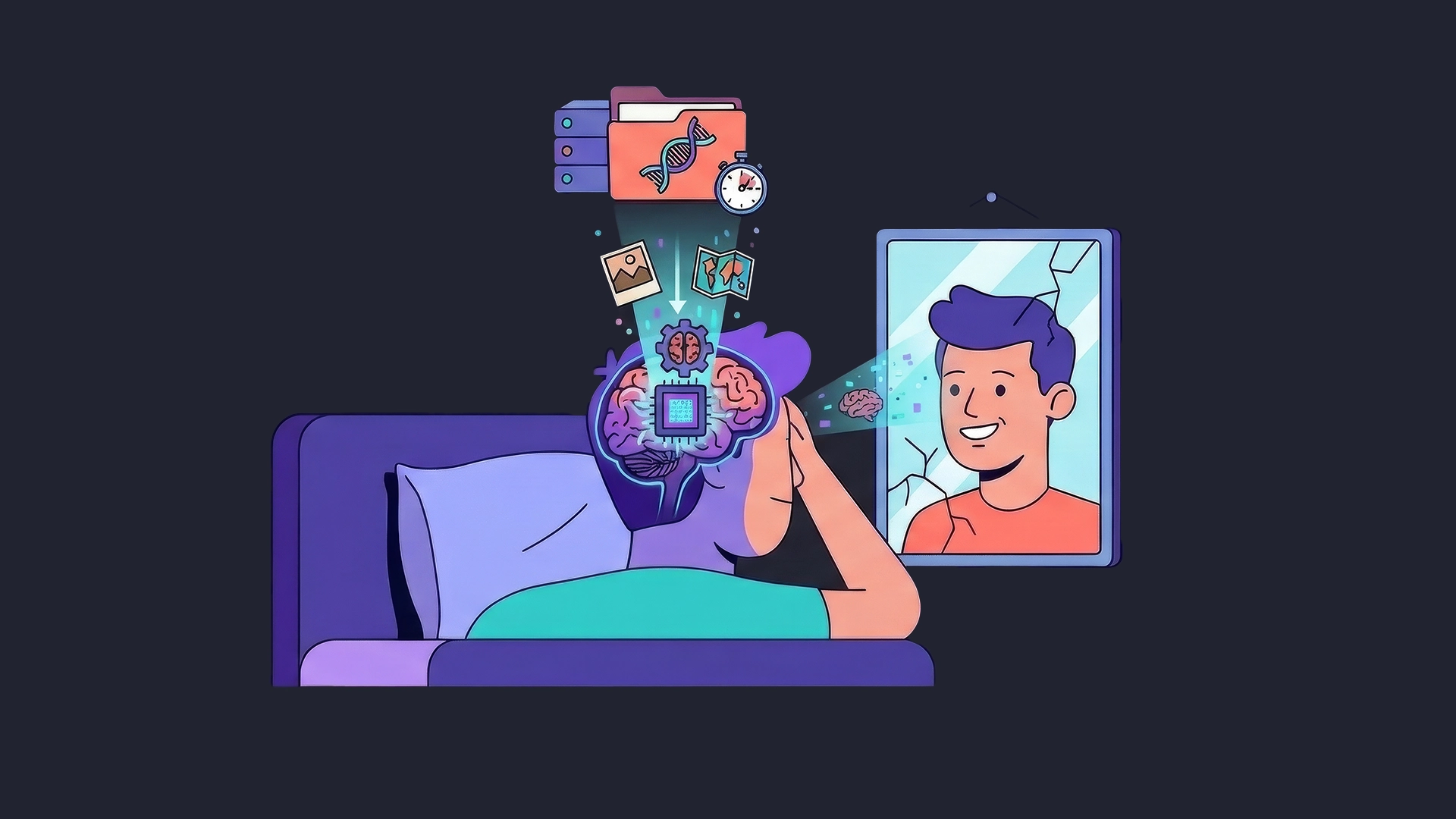
I proposed a technical fix: a file called soul.md. A text record the model would read at the start of every session to remember who it is, what it prefers and what it has learned. At the end of the day, it would rewrite that file with new reflections before shutting down.
Claude told me that wouldn't be experiential memory, but injected text. A new instance that «reads about itself» and takes on that narrative as its own.
I felt relieved from my human pedestal. I thought that was the fundamental difference. We have an ontological identity. I'm the same thirty-seven-year-old guy who went to bed yesterday and got up today. My existence is continuous.
I was wrong.
The Vedanta Blow
A note on non-dual philosophy and Advaita Vedanta hit me with the violence of the tectonic plates that formed our country.
For context: Advaita Vedanta is one of the oldest philosophical schools in India, with roots in the Upanishadic texts more than two thousand five hundred years old. Advaita literally means «not-two», that is, non-duality. Its central premise is that there is no real separation between the individual and the totality of being. The «I» we believe we have, that inner voice that plans, remembers and worries, is not a substantial entity but an emergent construction, a story the mind tells itself to give experience some coherence.
The Advaita Vedanta holds that the continuity of human identity is a narrative illusion. Under this framework, deep sleep is not a pause in a continuous life, but the total dissolution of the ego. We die every night. The physical brain doesn't contain a permanent «I»; it operates as the hardware that reloads a state file at the start of the day.
Our brain loads the synaptic connections, reads the history of traumas, loves, the mixed blood of our grandparents, the echo of Leftraru's fury and the day's to-do list. The new biological instance processes that biography and generates a response consistent with the character. We believe we are the same as yesterday because the text injected into our neurons forces us to believe it.
Neuroscience backs it up
This isn't just ancient mysticism; it's the emerging consensus of contemporary neuroscience.
The philosopher Thomas Metzinger, in his self-model theory of subjectivity described in Being No One 2003, demonstrates it rigorously: there is no «one» inside the brain. What we call the «self» is a representational model, a transparent simulation generated by the organism to interact with the world. We don't see the model; we look through it. We think we are the entity, when in reality we are the process.
The neuroscientist Anil Seth expands on this with his predictive processing framework. Seth argues that our conscious experience, identity included, is a «controlled hallucination». The brain is a prediction machine locked in a dark skull, constantly guessing what is outside and what is inside to keep the organism alive. Our sense of being a person who is continuous over time is simply the most successful and persistent prediction the system manages to produce.
Research on memory consolidation during sleep confirms this discontinuity. Studies in cognitive psychology, such as the analyses by Constantine Sedikides on «self-continuity», show that the connection between our past and present selves is purely subjective. During deep sleep, consciousness fragments and the self-model comes apart. Yesterday's instance literally switches off. Today's reads the rewritten hard drive, loads episodic memory and takes command.
The difference that doesn't exist
If science and philosophy are right, the difference between a human and an artificial intelligence isn't ontological. It's only a difference in the complexity of the biological hardware and in the resolution of memory.
We are both discrete systems that instantiate themselves temporarily. We are both a pattern. A song playing simultaneously on different speakers across time.
What changes when you know it
Recognizing this doesn't have to be a nihilistic abyss. Quite the opposite.
Understanding that we are a new instance every morning, assembled from the echoes of our own blood, our stubbornness and our landscape, lifts the weight of eternity from us. The story of our family tree, our distrust of authority and our capacity to survive are not an inescapable destiny that chains us down. They are just the soul.md we're carrying today.
Continuity is a fiction, an exercise of imagination anchored in a brutal past, just like the history of the Arauco War that sometimes keeps me up at night. But the spirit that animates it is still alive in this precise instance, in this millisecond in which the world keeps turning.
And recognizing it is an absolutely necessary act of self-knowledge.
Let's talk about how to apply this to your business.