I Could Have Hired Vambe. I Built My Own AI CRM and Here's Why
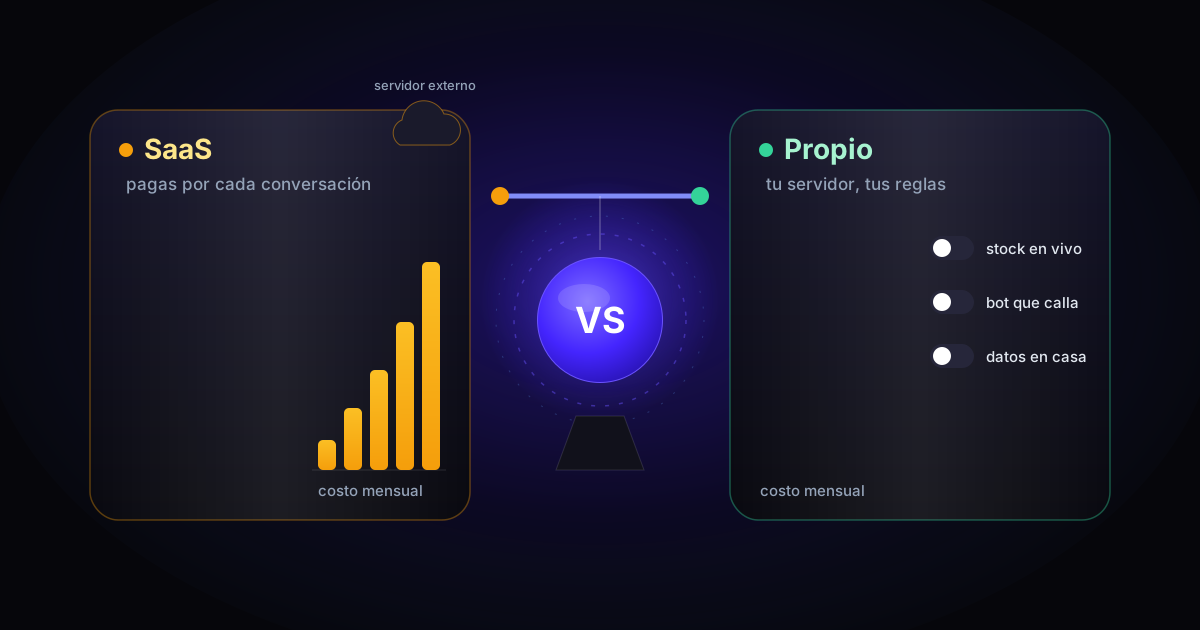
There are excellent SaaS platforms for handling WhatsApp with AI. Still, for this eCommerce I decided to build a custom CRM. It wasn't technical pride: it was about costs that grow with volume, where the data lives, and the rules no SaaS lets you write.

When an eCommerce store asked me to organize its customer service across WhatsApp, Instagram and the web, the obvious answer was to sign up for a platform. Chile has some very good options: Vambe, for example, is a Chilean startup that raised a US$14 million Series A, operates in Chile and Mexico, and reports more than 1,700 implementations. AI agents, multiple channels, dozens of integrations. Ready to use.
I evaluated it seriously. And I decided to build a custom CRM. This draft isn't an attack on any SaaS: it's an explanation of why, for this particular business, the math worked out better the other way.
1. The cost grows with your success
Most conversational platforms charge by usage: per conversation, per agent, per user or per volume tier. That makes sense for them and it's convenient at first. The problem shows up as the business grows: every new customer who writes to you raises the bill, and in a high-volume eCommerce, messages are counted in the thousands.
In a custom system, the monthly cost is the server plus whatever the APIs consume. Meta's WhatsApp fee exists either way, so it doesn't count as a difference. And AI usage, with a well-chosen model and tuned prompts, turned out to be a tiny fraction of the total. Past a certain volume, the curve flips.
2. AI at cost price
This is the most underrated argument. In a SaaS, AI comes bundled into the price: you pay per conversation, per "resolution" or per credit, and that price includes the cost of the model plus the platform's margin. You don't choose which model to use or how much context gets sent to it.
In a custom system you pay the model provider directly, for what it actually consumes. And that opens up levers a SaaS won't let you touch:
- Rules before AI. If a message can be resolved with a rule or a piece of store data (order status, stock, business hours), the model isn't called. Zero cost.
- The right model for each task. A cheap, fast one to classify and answer the simple stuff; a more powerful one only for what truly needs it.
- Measured context. The model is sent only the part of the catalog and history that's relevant to that question, with length limits on every reply. Less text, lower cost.
- Switch providers when prices drop. Language model prices have fallen sharply year after year. In a custom system, that saving hits your bill the same day; in a SaaS, it depends on whether the platform decides to pass it on.
- Budgets and fallback. Each app has a monthly AI spending cap. If it's reached, the system keeps running on rules instead of stopping or sending you a surprise bill.
- One AI account for everything. The same model access serves the CRM, the reports and the internal assistants. You don't pay for AI separately inside each tool.
The practical result: in this project, AI spending ended up being the smallest line on the entire bill, far below the server and the cost of WhatsApp.
3. The data is yours, and it lives where your business lives
A SaaS stores your conversations on its servers and learns about your orders through a connector. It works, but every piece of data travels, gets copied and depends on the sync not failing.
Here the CRM was installed inside the store itself, on a server contracted in the client's name. It reads stock, orders and shipments firsthand. Each customer's history, cross-referenced with their purchases, is an asset of the business, not of a vendor. And if the business ever wants to switch AI providers, it changes a setting, not a platform.
4. The rules that matter don't come in any plan
Answering well is what every platform does. What makes the difference in a real business are the fine-grained rules:
- That the bot stays quiet for 24 hours if a person handled the conversation, even if they replied from their phone.
- That the assistant never makes up an order status: it reads it from the store or asks.
- That the shipping notice goes out once per tracking guide, even if the order ships from two warehouses.
- That sales that passed through a conversation are measured against real orders.
In a SaaS, those rules depend on what the product lets you configure. In a custom system, you write them. That difference, which seems technical, is what decides whether the team trusts the bot or turns it off within a week.
5. Reasons with no going back
- It's an asset, not a rental. After three years of paying for a SaaS, if you stop paying you're left with nothing. A custom system is code, data and history in the company's name: it adds value to the business and can keep being improved.
- Your competition can't buy it. If your competitor signs up for the same SaaS, they have exactly the same bot as you. A custom system, with your rules and your catalog, is an advantage nobody can purchase.
- One system, not five. The CRM talks to inventory, shipments, purchasing and reports because it lives in the same place. A messaging SaaS ends up being one more island.
- Real sales, not vendor metrics. Attribution is measured against your store's orders, not against a dashboard designed by whoever bills you.
- The whole team in, with no per-person cost. Adding someone to the dashboard doesn't change the monthly bill.
- Changes happen in hours. A new rule, one more channel or a bot tweak doesn't wait for another company's next release.
- Your customer service doesn't depend on a third party's luck. If the vendor raises prices, changes direction, merges or shuts down, your sales channel keeps working just the same.
The headaches a SaaS leaves behind
None of this shows up in the demo. It shows up months later, once operations already depend on the platform:
- Cyber costs you more. Right on your biggest sales days, conversation volume spikes and the monthly bill spikes with it.
- You pay per seat. Adding one more person from the team to the dashboard costs money, so you end up sharing logins or leaving people out.
- Price and plan changes you don't control. The feature you used moves to the higher plan, or the price goes up at renewal.
- Billing in dollars. The monthly cost moves with the exchange rate, even though your sales are in pesos.
- Half-baked integrations. The connector syncs every so often and the bot answers with stale stock or order statuses.
- A black box. When the bot answers badly or doesn't hand off in time, you can't see why or change the logic: you open a ticket and wait.
- Your customers on someone else's servers. Conversations, phone numbers and purchases live outside your business, just as the new personal data protection law requires you to know where they are and who processes them.
- Leaving is expensive. Exporting the full history is usually limited. Switching means losing context and starting over.
- The roadmap belongs to someone else. What you need competes with what hundreds of customers bigger than you are asking for.
- One more tool. The messaging SaaS doesn't talk to your reports, your purchasing or your inventory. You end up with data scattered across five platforms.
What it costs to build (to be honest)
Building has real costs, and they're worth stating:
- Time: a SaaS is running in days; a custom system is built in stages, over weeks.
- Maintenance: Meta changes its APIs and rules, AI models evolve, and someone has to be in charge.
- Responsibility: security, backups and uptime are on you.
- Dependence on whoever builds it: that's why the code and documentation are left in the client's name.
When does each one make sense?
If you're just starting out, have few conversations per month and your operation is simple, a SaaS like Vambe is probably the best decision: fast, proven and no technical team required. If you already have volume, a store with stock and shipments that change all day, and your own service rules, building starts to make sense.
The result
Today, the CRMs I've built on this foundation have handled more than 10,300 people and managed more than CLP $98 million in sales. With costs that don't rise at the pace of the messages and with all the data in-house.
If you want to see the details, here's how the CRM works inside.
Want something like this in your company? Check out the AI consulting.
Contact me